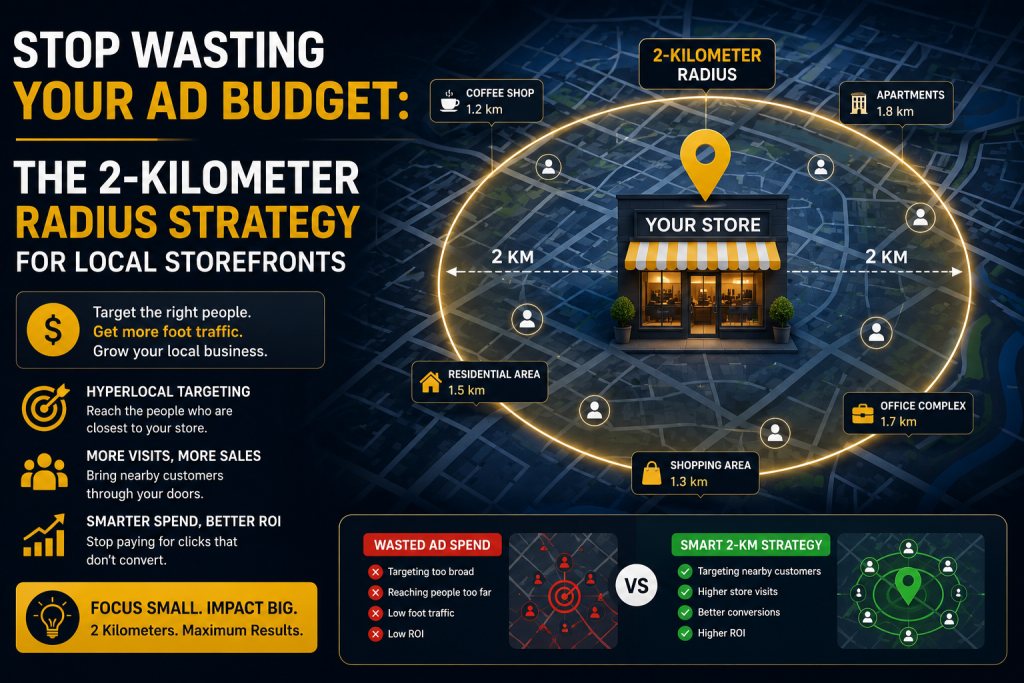
Stop Wasting Your Ad Budget: The 2-Kilometer Radius Strategy for Local Storefronts
If you run a local storefront—whether it is a boutique apparel store, a cozy neighborhood cafe, a specialized electronics shop, or a fitness studio—you have likely tried running digital ads on platforms like Facebook, Instagram, or Google. And if you are like most small business owners, you might have walked away feeling frustrated. You spent thousands of rupees, saw thousands of “impressions” and “clicks,” but when you looked at your front door, the foot traffic remained virtually unchanged. What went wrong? The truth is simple: You were likely showing your ads to the wrong people. Most generic marketing agencies set up ad campaigns that target an entire city or a broad region. But for a physical shop, showing an ad to someone living 20 or 30 kilometers away is often a complete waste of money. Most people will not travel across town in peak traffic just to buy a t-shirt or grab a coffee. At DeepScale, we believe in a different, data-backed approach: Hyper-Local Hyper-Targeting. By locking your ad delivery to an exact 2-kilometer radius around your physical store, you stop burning your hard-earned money and start dominating your immediate neighborhood. Here is your exact, step-by-step guide on how the 2-kilometer strategy works and how it can scale your storefront’s foot traffic. The Big Problem: Broad Targeting is Silent Budget Leakage When a business owner creates an ad for the first time, ad networks default to broad audience settings. They encourage you to target entire metro areas to “reach more people.” While “reaching more people” sounds great on paper, it misses the reality of human behavior in physical retail. Why broad local targeting fails:Distance Kills Intent: A potential buyer might like your product photo, but as soon as they tap your address and realize you are an hour-long drive away, they drop off. You paid for that click, but you lost the store visit. Diluted Budget: If you have a budget of ₹300 to ₹500 a day, spreading it across millions of people in a big city means each person sees your ad once (or never). They forget you instantly. High Competition: Broader targeting puts you in direct bidding wars against massive e-commerce brands and national chains with giant marketing budgets. To win as an independent local business, you don’t need to capture the whole city. You only need to capture the high-intent buyers living, studying, or working right in your backyard. The Solution: What is the 2-Kilometer Radius Strategy? he 2-kilometer strategy (also known as micro-geo-fencing) is the practice of drawing a tight digital border around your physical street address inside your ad manager platforms. Instead of shouting to the entire city, your ads create a dense, highly visible digital presence exclusively for people within walking distance or a short 5-to-10-minute drive from your door. When you shrink your geographical focus, something magical happens to your advertising budget: your ad frequency goes up among local residents without increasing your cost. Instead of 10,000 strangers seeing your ad once, 1,000 neighbors see your ad 10 times. That repetition creates brand familiarity, trust, and real-world action. Part 1: How to Set Up Radius Targeting on Meta & Google Setting up hyper-local targeting is surprisingly straightforward once you know where the settings are hidden. Meta Ads (Facebook & Instagram) When creating a campaign in Meta Ads Manager: Choose Drop Pin instead of typing a broad city name. Place the pin precisely on your store’s location on the map. Change the default radius slider down to 2 km (or 1 mile). Under the location options, select “People living in or recently in this location.” This catches both local residents and workers currently in your area. Google Smart & Search Ads When setting up local search campaigns: Select Location Options -> Enter another location -> Advanced Search. Click on Radius targeting. Type your business address, set the distance to 2 km, and save it. Add targeted local search terms like “clothing store near me,” “best cafe in [neighborhood name],” or “shoe shop open now.” Part 2: Time-of-Day Triggers (Ad Timings That Match Foot Traffic) Location is only half the equation. The second half is timing. Running your ads 24 hours a day means spending money when people are sleeping or when your shop doors are locked. The 2-kilometer strategy relies on smart ad scheduling (dayparting). Examples of Time-Triggered Campaigns:The Lunch-Hour Rush (For Cafes & Food Outlets): Schedule your ads to turn on automatically between 11:00 AM and 2:00 PM. Target office workers or college students within 1.5 km offering a quick lunch deal or a afternoon refreshment discount. The Evening Commute (For Apparel & Retail Stores): Run ads between 5:00 PM and 8:30 PM targeting residents on their way home. Show them new arrivals with a simple call to action: “Stop by on your way home tonight—we are open until 9 PM!” The Weekend Shopping Surge: Increase your ad frequency on Friday evening and Saturday morning when locals are actively planning their weekend errands. By pairing a tight 2 km radius with specific operational hours, every single ad view hits a customer at the exact moment they can actually act on it. Part 3: Creating Hyper-Local Ad Content That Converts When your audience is hyper-local, your ad copy and visuals should reflect their immediate surroundings. Generic stock images or corporate polish won’t work as well as authentic, recognizable content. 1. Name the Neighborhood or Nearby Landmarks Use real local names in your headline. People naturally pay attention when they see their immediate surroundings mentioned on social media. Bad Headline: “Buy Quality Oversized T-Shirts at Great Prices.” Hyper-Local Headline: “Living near Salori or Katra? Stop by our store today for the freshest oversized tees in town.” 2. Use Recognized Visual Backgrounds Shoot your ad videos or photos right outside your storefront or on your main street. When a local scrolling through Instagram recognizes the street corner or the shop sign, their thumb stops scrolling. It triggers instant recognition: “Oh, that’s right down the street